Don't let Concord make decisions for your town.
Question 2 will say "limit property tax growth." What it really does is put Concord's rules on your town's schools.
Shall the town limit property tax growth for its school district(s)…? If adopted for a two-year period…
Your town already said no.
New Hampshire towns can already vote to cap their school budgets at their own school district meetings. When towns have tried, voters have said no again and again.
Concord didn't like the answer. Two days after most towns rejected their caps, the House voted to force caps on every district. House Majority Leader Jason Osborne called town meeting decisions "the tyranny of fringe special interests."
He's talking about your neighbors. And you.
In January 2026, the House killed a statewide school budget cap after Republicans joined Democrats to vote it down. So Concord tried another way. A new law requires every town in New Hampshire to put this cap on the November ballot, this year and again in 2028. They'll keep asking until they get the answer they want.
In New Hampshire, we decide things for ourselves. Question 2 hands that decision to Concord.
If [local voters] are unwilling to cap themselves, the state will step in and cap local taxes for them.
5 reasons to vote no
Nobody can explain it.
Three different rules are packed into one yes or no vote. The ballot says the cap is "for a two-year period," but the law itself doesn't say that anywhere. If the people who wrote it can't explain it, you shouldn't have to guess.
A bigger town could decide for yours.
Many towns share a school district or SAU (School Administrative Unit). If a larger neighbor votes yes and your town votes no, their vote can win, and your town has to live with it.
It could cost teachers and the programs that keep kids in school.
The new caps don't match how real school budgets work. In one district, the 6% admin limit alone would leave them about $200,000 short, and that's before health insurance. Costs like health insurance, transportation, and special education keep rising whether there's a cap or not. When those take a bigger bite every year, something else gets cut: sports, music and theater, AP classes, career and technical programs, clubs, field trips. Then teaching jobs, and bigger classes. Kids lose the help they need, and schools can't compete for the best teachers.
Schools are why people put down roots here.
Families move to a town for its schools, then stay because of the people they meet there. The parents next to you at pickup become friends. The kid you watched in the fourth-grade play ends up coaching your daughter's soccer team. When the school gets squeezed, everyone feels it, and so does your home's value.
Public schools take every child.
Private schools can say no to accepting a student. Your public school can't. It serves every child who walks in the door, including kids with disabilities, kids learning English, and kids going through hard times at home. The law requires those services, and they come with real costs: specialists, coordinators, paperwork. A cap doesn't change any of that. It just limits the resources available for everything else. The more a district does for kids who need extra help, the harder this cap hits. Those are your neighbors' kids. Those may be your kids or grandkids.
Why are property taxes so high?
It's not because school districts across the entire state are on a spending spree. New Hampshire pays the smallest share of public school costs out of all 50 states. That means our cities and towns have to cover more than 70%, mostly through property taxes.
In 2025, the New Hampshire Supreme Court ruled that the state underpays. The minimum cost of an adequate education is at least $7,356 per student. The state was paying about $4,200. That's a gap of roughly $500 million a year, and your property tax bill covers it.
Instead of closing that gap, lawmakers rewrote the definition of an adequate education. Asked whether the change would add any state money for schools, the bill's sponsor said no.
Question 2 doesn't fix any of that. It just tells your town to make do with less.
We need real solutions, not political gimmicks.
Who pays for New Hampshire's public schools?
Nearly three out of every four dollars come from property taxes.
Source: NH Department of Education, State Summary Revenue and Expenditures of School Districts, 2024–25.

Why schools matter
Think about the last time you were in a packed gym or on a cold set of bleachers, cheering for a kid who isn't yours because they're wearing your town's name. Or the last concert, play, or graduation where you ran into someone you hadn't seen in months.
Most of us spend more time on screens than ever and less time with the people who live down the road. The school is where a town still shows up for its kids, and for each other. It may even be where you're going to vote on November 3.
Quick answers
Does Question 2 cut my taxes?+
No. It only limits how fast school taxes can grow, and they can still go up with inflation. The real driver of high property taxes is that the state pays so little of the cost of schools. A cap doesn't fix that.
Where is the state's school money going?+
To private school tuition families were already paying. The voucher program was budgeted at $129,000 when it started. This year it could top $60 million. Only 7% of new voucher students last year came from a public school. Concord is paying for it out of the same fund meant for your kids' schools, then capping your school's budget.
Doesn't it protect classrooms?+
The ballot promises the cap won't affect classroom instruction. But the budget cap and the admin cap are separate rules, and when costs keep rising, there may be nothing left to cut except what happens in the classroom.
What if the state cuts our aid again?+
The cap doesn't account for that, and it's already happening. The state is phasing out aid that protected towns from losing funding, and 145 towns and cities got less state education aid for the 2025–26 school year. Under a cap, your town can't make up the difference. The school takes the hit.
Can't my town already do this?+
Yes, at your annual school district meeting, decided by the people who live there. Towns across the state have voted on caps over the last two years, and voters keep saying no.
Why does this hit some towns harder?+
A cap freezes every district where it is today. Towns with less property wealth, which are already stretched, get stuck there. And public schools must serve every child, including kids with special needs, no matter what the cap says.
What if I just skip it?+
Blank votes don't count. Question 2 needs 60% of the people who answer it to pass. Every NO counts.
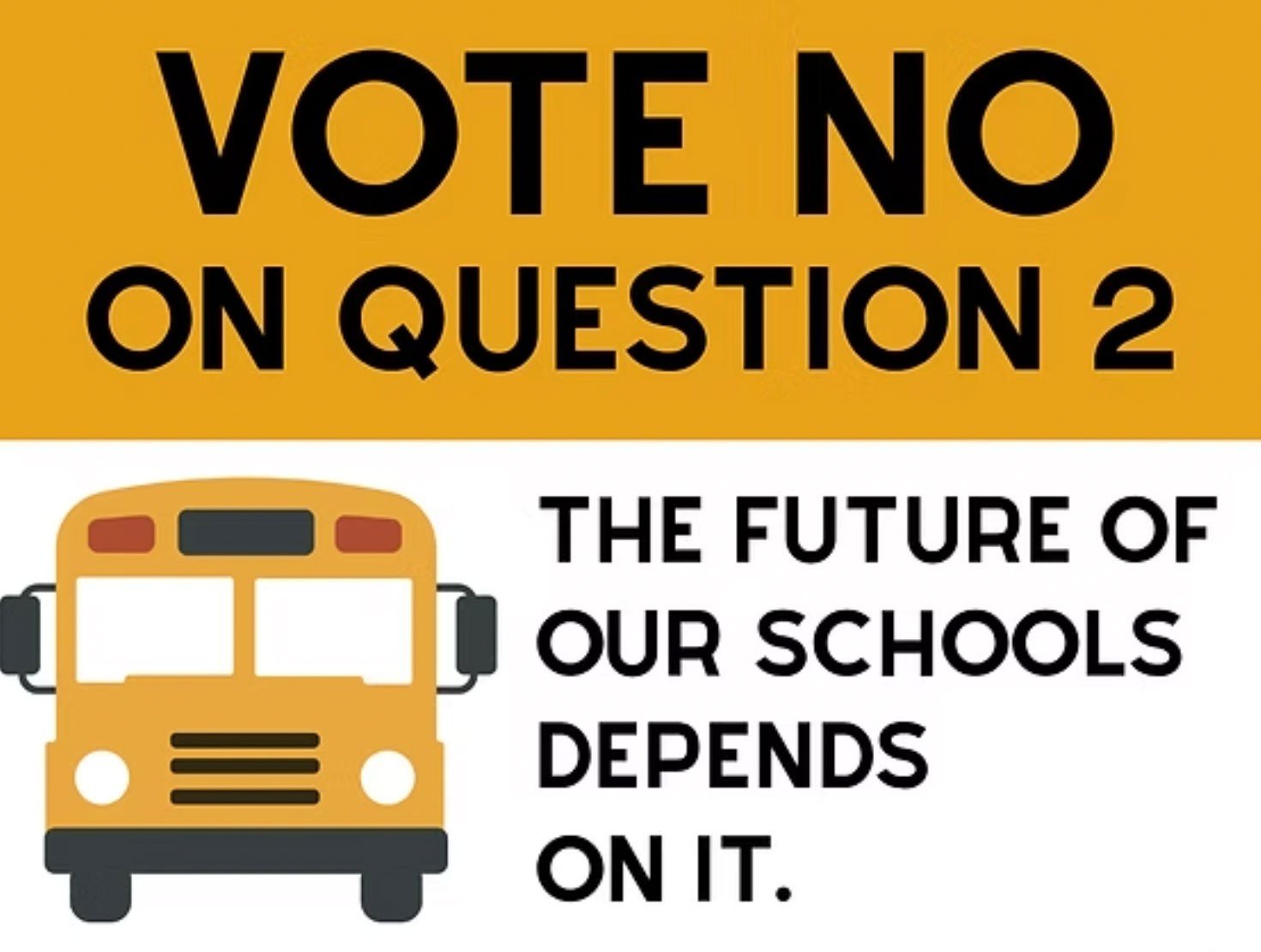
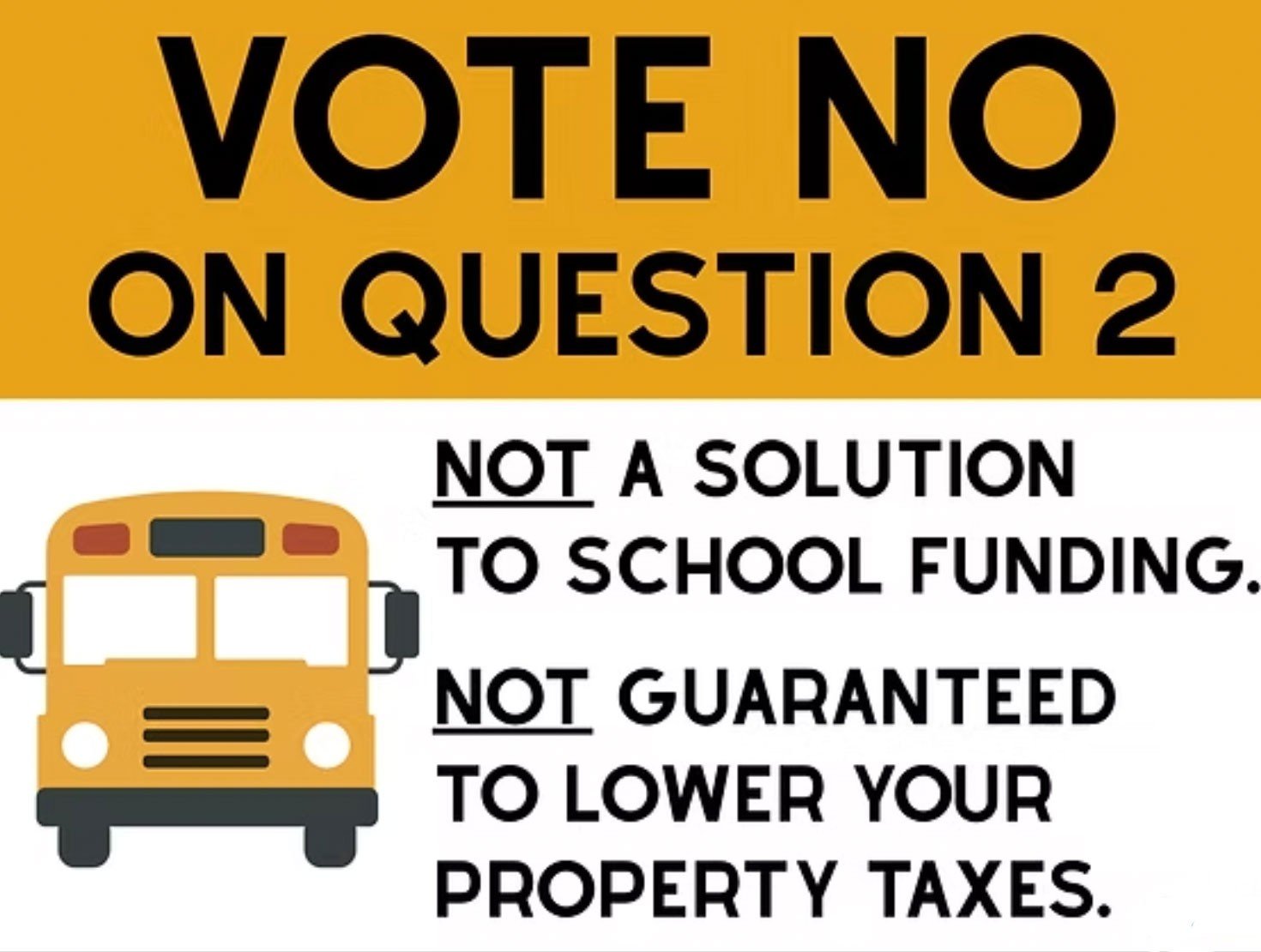

If it doesn't add up, vote it down.
Vote NO on Question 2.
Sources: check our work+
Your town already said no
- NH School Funding Fairness Project: 2025 cap votes, including Kearsarge 1,435–113
- NHPR, Feb. 2025: Osborne, “the state will step in”
- NHPR, Mar. 2025: Osborne, “tyranny of fringe special interests”
- NHPR, Mar. 2026: nine communities reject tax caps
- NH Bulletin, Jan. 2026: House kills statewide school budget cap
What Question 2 does
- Reaching Higher NH: What HB 1300 means (two-year wording, shared districts, the 6% admin cap)
- NHPR, July 2026: Governor signs HB 1300, putting the question on every ballot
- HB 1300 bill text
Why property taxes are so high
- ConVal v. State (2025): NH Supreme Court ruling on the $7,356 minimum
- Concord Monitor: the roughly $500 million a year gap
- Business NH Magazine: HB 1815 sponsor says the bill adds no state aid
- Network for Public Education: cities and towns cover over 70% of school costs
- Chart data: NH Department of Education, State Summary Revenue and Expenditures of School Districts, 2024–25
Quick answers
- NHPR, Sept. 2021: voucher program budgeted at $129,000 in its first year
- NHPR, Aug. 2026: voucher program could top $60 million this year
- Monadnock Ledger-Transcript, Sept. 2026: about 7% of new voucher students came from public schools
- NH Fiscal Policy Institute: 145 municipalities received less state aid in 2025–26